You know those little guys that we all learned in high school biology that are the building blocks of life? Yea, they're important. I do a lot of work with cells, and I want to talk about some of those procedures.
To begin with, the type of cells that I work with are Human Embryonic Kidney 293T cells. Known as HEKs or 293Ts. A cell line is a group of immortalised cells. You can order them from a company, and you know what you are getting. HEK 293s were originally from a "healthy aborted fetus" in the 1970s. The number 293 comes from Frank Graham (the guy who immortalised this cell line), who numbered each of his experiments. Thus, HEK 293s came from his 293rd experiment.
HEK 293s are not just plain human cells. A bit of adenovirus 5 DNA was added and incorporated into the human chromosome. This is what gives them their immortality.
Ours are not just plain 293s, but 293Ts. This means that they are able to be transfected with plasmids easily. More on that later.
The way we work with these cells is very cyclical, so I really could start anywhere in describing the process.
We'll start with a flask filled with cells. The cells are in media (read food). We use DMEM as our media. DMEM is composed of amino acids, salts, glucose, vitamins, iron, and phenol red. Phenol red is very important. It is a dye that changes color based on how acidic it is. Mixed into our DMEM is fetal bovine serum (FBS) and a penicillin/streptomycin mixture. The FBS is what is left of the liquid portion of fetal cow blood after it is allowed to clot. It does not have blood cells in it, is low in antibodies, and has a good amount of growth factors. The pen/strep mixture is antibiotics so that the cells don't get infected.
You pull your flask out of the incubator (37 degrees C and 5% CO2), and you notice that the liquid (media) is a dull orange. Time to change the media! Why? Well, remember that phenol red? It starts out a reddish-pinkish color. When it gets too acidic (cell excrement makes it that way), the cells will die. Imagine living in your own poop. Even if you get nutrients from the air, after a while there is just too much poop, and you suffocate from it. Same sort of thing. The change in color signifies that it is becoming too acidic. These particular cells are called adherents. This means that they stick to a surface. In this case, they stick to a side of the flask (whichever end was down). So you flip the flask over, and all the liquid is on the opposite side from the cells. Now you can use an aspirating pipette (also known as a vacuum) to pull out the spent media. If you just want your cells to grow more, you will add more media. This is known as changing, swapping, or replacing the media.
Let's say that before you swapped the media, you looked at your flask under a microscope. You found that there was some overcrowding going on. This is another leading cause of cell death. If cells do not have space to grow in, they die. Sometimes something peculiar happens and the cells on the edge will start growing up the walls. Sometimes, they don't have good anti-gravity skills and the off-the-wallers become curlers. A film of cells will curl up off the wall and back into the cells. It may look cool, but it definitely means your cells are unhealthy (I know from experience).
How do you deal with cell-overcrowding? Decimation. You suck off the old media, and put in a little bit of trypsin-EDTA. The trypsin will cleave proteins (it's actually one of the digestive enzymes that digests proteins in humans), and the EDTA prevents the cells from clumping. You leave that in the incubator for five minutes, and all your cells will come off the walls/floor of the flask. You then spray them down with media so any clingers are forced into the solution. You pipette up and down to make sure everything is mixed nicely, and usually you pull off 9/10 of the liquid (and thus the cells) in the pipette. Then you vaccuum them. You are left with 1/10 your original cell count (-ish) and you add more media to get back to your original volume. I have found that doing this generally gives you three or four days before your cells are confluent (overcrowding) again.
We have cells. We know how to maintain them. What's the point? In our case, the point is usually transfection. Transfection is introducing foreign DNA for the cell to incorporate in its own genome. You put your cells in solution, and instead of vaccuuming a large portion of them, you then add that portion to a different flask. You then add an appropriate amount of media, and do some heavy mixing. Then you add about 10 ml of this new solution to your cell culture plates. You may know them as petri dishes. Your cells will grow and flourish (hopefully), and reach confluency.
After a couple of days, when it is time to change the media, you can transfect them. You put a bit of the DNA that you hope to express in a mix with media and a special reagent that will make a hole in the cell membrane for the DNA to go through. You add a few drops of this mix to each plate, and the new foreign DNA gets pulled into the cell. If everything worked well, the cell will think, 'Huh! There is DNA outside of the nucleus. Better put that back where it belongs!' The cell adds the new DNA to its own, and then acts as though nothing is different. In our case, the foreign DNA will code for a particular protein.
After another couple of days, the cells had enough time to produce that protein, and you can harvest them. This is done by basically scraping each of the plates, and sucking up the cells that were on there. There are a number of things that can be done after you have harvested the cells, but that is outside the scope of this post.
Now, you are an expert on cell culture! (-ish)
Thursday, May 27, 2010


Thursday, May 20, 2010
General Updates
A lot has happened in the last few weeks. To start with, I no longer live with JK. He went away on vacation for about a week, I watched Hershey the dog, and when he came back, I moved out. This was planned, and I gave plenty of headway.
I currently am living in an apartment that's actually in the center of town. It is a little bit less than two miles to get to the base. In fact, I turn right out of my apartment, turn right at the end of the street, and if I keep going straight, I end up on base. Win.
AK finished up school for the year, and came down to live with me. Timing worked out really well there. She finished up her finals and whatnot before the end-end, and I had a meeting to finish up Division II with JM and CJ. I went up to Amherst for my meeting, brought some great beer to celebrate (Three Philosophers. If you haven't tried it, do so). JM and CJ asked me all sorts of questions to gauge the sorts of things I have learned in the last two years. This is, of course, after I had given them a portfolio and retrospective essay. That way, they knew about which things to ask questions.
After the meeting, AK and I drove down to my folks' house. We had some dinner and grabbed a few things that I had not brought down the first time around. In the morning, we drove down to Frederick. And, I, smartypants that I am, went in to work. I had a nuclear extraction to do (I will explain that in more detail in a different post), and it took me about five hours. I had just driven about five hours, and then I worked for five hours. A glutton for punishment.
AK and I went tag saling last weekend. We bought a table, chairs, a microwave, a toaster, and various knick-knacks. Our apartment is starting to look homely.
AK is on the hunt for the elusive "job." She has applied to probably 30 places by now... So far, no dice. But, not all of them have rejected her yet either. If nothing comes, she is planning on volunteering. Probably with the local animal shelter.
I have been falling more and more into a routine. Aside from nuclear extractions that take about five continuous hours, it is mostly hurry up and wait. Right now, I am waiting for a gel electrophoresis (1.5 hours). After that, I do about ten minutes of stuff, and wait another 1.5 hours, etc.
I currently am living in an apartment that's actually in the center of town. It is a little bit less than two miles to get to the base. In fact, I turn right out of my apartment, turn right at the end of the street, and if I keep going straight, I end up on base. Win.
AK finished up school for the year, and came down to live with me. Timing worked out really well there. She finished up her finals and whatnot before the end-end, and I had a meeting to finish up Division II with JM and CJ. I went up to Amherst for my meeting, brought some great beer to celebrate (Three Philosophers. If you haven't tried it, do so). JM and CJ asked me all sorts of questions to gauge the sorts of things I have learned in the last two years. This is, of course, after I had given them a portfolio and retrospective essay. That way, they knew about which things to ask questions.
After the meeting, AK and I drove down to my folks' house. We had some dinner and grabbed a few things that I had not brought down the first time around. In the morning, we drove down to Frederick. And, I, smartypants that I am, went in to work. I had a nuclear extraction to do (I will explain that in more detail in a different post), and it took me about five hours. I had just driven about five hours, and then I worked for five hours. A glutton for punishment.
AK and I went tag saling last weekend. We bought a table, chairs, a microwave, a toaster, and various knick-knacks. Our apartment is starting to look homely.
AK is on the hunt for the elusive "job." She has applied to probably 30 places by now... So far, no dice. But, not all of them have rejected her yet either. If nothing comes, she is planning on volunteering. Probably with the local animal shelter.
I have been falling more and more into a routine. Aside from nuclear extractions that take about five continuous hours, it is mostly hurry up and wait. Right now, I am waiting for a gel electrophoresis (1.5 hours). After that, I do about ten minutes of stuff, and wait another 1.5 hours, etc.
The smallest things
Today, a package came for AB (not an altogether uncommon experience). It was probably about 8x6x5 inches. Inside it was another box, about half the size, with nothing else. Fischer Scientific (the sender) is claiming to go green, but I have yet to see any evidence.
Inside this second box, was... labelling tape. Twelve rolls. This is basically colored masking tape, but a little bit stronger so you can color code/label your experimental items. There was only one roll each of blue and orange, but two rolls of white, yellow, green, pink, and red. I asked AB, and he said that blue and orange are the most popular colors so they sell those separately. No, that does not make any sense to me either.
AB decided he had to put the colors in the right, most useful order. We have a tape dispenser that can accomodate eight rolls of tape, so that is one of each color, plus one of scotch-type transparent tape. AB spent the next five to ten minutes putting them in the "right" order. Previously, I had just used whatever tape was closest or whatever, but now it seemed like there was a correct and incorrect tape to use for different circumstances. I asked AB. He said, "Of course the colors have meaning. Everything has meaning." I made a face that begged for a more complete response, but none was forthcoming.
He had seven rolls on there when he said, "Hmm, but where does the pink go?" He thought about it for a moment, and took a few rolls off, put the pink on then replaced the rest. The final order is transparent, orange, red, pink, yellow, green, blue, white. He glanced up at me and looked really pleased with himself. I had an urge to pat him on the head and say, "Good boy!"
It's the smallest things that make people happy.
Inside this second box, was... labelling tape. Twelve rolls. This is basically colored masking tape, but a little bit stronger so you can color code/label your experimental items. There was only one roll each of blue and orange, but two rolls of white, yellow, green, pink, and red. I asked AB, and he said that blue and orange are the most popular colors so they sell those separately. No, that does not make any sense to me either.
AB decided he had to put the colors in the right, most useful order. We have a tape dispenser that can accomodate eight rolls of tape, so that is one of each color, plus one of scotch-type transparent tape. AB spent the next five to ten minutes putting them in the "right" order. Previously, I had just used whatever tape was closest or whatever, but now it seemed like there was a correct and incorrect tape to use for different circumstances. I asked AB. He said, "Of course the colors have meaning. Everything has meaning." I made a face that begged for a more complete response, but none was forthcoming.
He had seven rolls on there when he said, "Hmm, but where does the pink go?" He thought about it for a moment, and took a few rolls off, put the pink on then replaced the rest. The final order is transparent, orange, red, pink, yellow, green, blue, white. He glanced up at me and looked really pleased with himself. I had an urge to pat him on the head and say, "Good boy!"
It's the smallest things that make people happy.
Wednesday, May 5, 2010
Umm...News?
First, I realize it's been a while since last I updated you on life in the lab. I have been falling into a bit of routine. I now have my very own laboratory notebook, in which I need to detail my experiments. It's like I'm a real scientist. I have also gotten pretty good at all aspects of PCR. Yesterday, I loaded a gel after PCR, and it was a real beauty! Even better, it showed that everything worked very nicely.
Hampshire's only molecular/cell biology class with lab is called Gene Cloning. It is every January. It is a three week, 8 hours a day, intense lab boot camp. My thoughts: how could they possibly learn anything useful (read: do any experiments well) in such a short period!? I have been at this now for 7 weeks, and I work eight hour days! I am only starting to get good at some things.
Today and tomorrow are the Spring Research Festival. I went and explored. It was awesome (in the quite literal sense- I was filled with awe). Think huge circus tent. Or exhibit hall if that suits you. Eight rows of tables. Easily 50 tables long. It was huge. If you register, you get a free t-shirt upon entering. It's a nice one too. I thought the easiest way to approach this was to start on the right and work my way down the tent. It seems that this is how it was organized, so it was a good choice.
Most of the tables on the right were Department of Defense, National Cancer Institute, Fort Detrick related things. This included this included childcare services, Fort Detrick's recycling program, NCI-F's library services, etc. I got a very nice pen from USAMRIID. I think that is the Army's bio-warfare science unit. It is a very nice pen though.
The next section was posters. This was mostly postdocs showing off their work. I felt bad for them. I walked down one row of posters, and it was enough. I emerged on to something that my mind had a hard time coping with.
I've only been to one kind of trade show in the past. Jewish. I have been to lots of Jewish conferences, and they often have exhibit halls. Publishers show off books, leatherers show off book-bindings, there are pretty things wrought in silver, and other pretty things woven of fabrics. A science trade show is like walking onto a movie-set for some futuristic something-or-another. There was a booth filled with really pretty tools for cutting, namely scalpels, scissors of various shapes and sizes, and tweezer-like objects. There were incubators from cute to discreet to "huh, that looks like an incubator," with sales-people showing off all their interesting features. There was a robotic pipetting booth. Basically, you use a computer program to tell it origin and destination information (and it is all color-coded and click friendly), and the robotic arm pipettes just the right amounts of the right stuff into the correct destination.
Food was brought by ZiPani, a sandwich place in town. I went there once with AK because a name like that might lead you (as it did us) to believe that it is a bread place. I got a sandwich at the ZiPani stand (it was pretty cheap and there was no sales tax!), and sat down out side at one of the picnic tables.
One of the exhibitors joined me, and his business is based in Natick MA, so he was quite familiar with Amherst, and even knew about Hampshire. He was a real pleasure to chat with. It was fun. Aside from the requisite business name and his own name, his name tag said, "Likes broccoli and is good with kids!" He was a pretty cool guy.
I came back and had to do a nuclear extraction.
A few days ago, I put some cells on cell culture plates, and transfected these cells with some DNA. This means that I inserted DNA into the cell, with the hopes that the cell would then express (manufacture) the protein that the DNA codes for.
After the cells have been expressing this protein for a couple days, I basically scrape the cells off of the plates, and put them in test tubes. The cells then get put in a centrifuge, and I separate off the liquid. I then add materials that will allow me to extract the nuclei of the cells after spinning them down again.
Today, it did not work. I noticed when scraping the cells that they were "gummy." As in, they stuck together in long strands. When I sucked them up in my pipette, they pulled like boogers. I put them in the centrifuge, and when I took them out there was no pellet. Normally when you run the centrifuge, all the heavy stuff sticks together and forms a "pellet" at the bottom of the tube. You can then suck off the liquid, and you are left with the pellet. Either you add something else at this point and re-centrifuge or you stick it in the freezer depending on what you are trying to get from the pellet.
No pellet formed. We thought that maybe I didn't spin the centrifuge fast enough, and thus there was not enough force to separate the pellet from the liquid. We spun it faster. No good. A few of the tubes looked like they might have a pellet, but when I tried to pull the liquid, the boogers came with it.
So what does this mean? It means that my cells died before I scraped them. I admit that I did not check on them under a microscope since I transfected them (two days ago). But they should have been healthy. We were using a different serum this time. Normally we put FBS (fetal bovine serum) in the media, and the cells grow very happily. However, we were out of FBS, and we used a different company's FCS (fetal calf serum). These really should be the same thing. So naming conventions aside, the difference was that the FCS was heat-treated. The going theory at the moment is that my cells were acclimated to our regular serum/media combo, and the shock of changing this was detrimental to them. Who knows? No use speculating.
So on Friday, I will start a new transfection process.
In other news, NIH has apparently censored signing in to a blogger blog. I am able to read blogs, but theoretically not post or comment. I happened to have set up a way to blog by email. Unfortunately, I can't check formatting and whatnot. Hopefully that works.
--
-Tal
Thursday, April 15, 2010
Practice makes perfect
So... my PCR from a couple of days ago kind of failed. Yesterday, I did an agarose gel electrophoresis. This is basically to see whether the PCR was successful, and it was not.
Gel electrophoresis is really cool. You start with an individually sealed package. Inside, is a plastic slab. The plastic slab houses a "gel." In this case the gel is agarose, the sugar-matrix that is made from red algae, and is used in lots of deserts and "seaweed salad" in Asian foods. Read more about it here. The gel has wells at the top. These are very small holes where the gel is cut out. You put the gel-slab rectangle into a bigger plastic box. It is covered with a buffer solution that is electro-conductive. There is a cathode and an anode (positive and negative electric terminals) on either end of the box, the DNA itself is electrically negative. Below is a picture of the slab in the electro-conductive box.

At the top, against the blue background, you can see the wells. A pipette is used to load material (in our case, DNA) into the gel.
First, it is really difficult to get the pipette right into the well, and further to put your material in there. Light is refracted against the buffer solution, and makes aim difficult. You are also using this long pole (the pipette) with a tiny end that needs to fit inside a tiny hole. Regardless, once you have the material in place, you seal the box. It is connected to wires that are connected to a power supply. It's basically a completed circuit. Electricity flows from the anode (negative) through the gel to the cathode (positive). It also pulls the DNA along with it.
Before putting the DNA in the wells, dye was added. This dye, called Ethidium Bromide, binds to each base of DNA- one molecule of dye for each base. This dye allows you to see how far the DNA ran on the gel. The farther the band, the smaller the molecule. Basically, the smaller the molecule, the faster it goes when electrocuted. The location of a band on the gel tells you what you are looking at.
When the electrophoresis is over, you take the gel to a chamber that emits UV light. This is a small light-proof box. You put the gel inside, and seal it up. You turn on the UV light, and can take a picture of the gel using a camera in the box. Ethidium Bromide glows when it is lit by UV light. The resulting photograph shows the bands where there is Ethidium Bromide and thus DNA.
The following is a picture of the UV illumination:
The more dense a band is, the more material there is.
With the gel that I ran, shown below, the left-most column was a mistake, and is to be disregarded. The second from the left is a negative control. It was basically only dye, to have a scale. The third is the positive control. The fourth and final column was my experiment. It was looking for a region called DMR. You see that band at the bottom of the the final one? That is DMR. I found it. However, the problem is the control. It is blurred and crazy. We have no idea what exactly went wrong there.

So the DMR is good, but the control is messed up. We can keep the DMR that I made in PCR, but have to run the control again, else we won't be able to actually experiment with it.
AB decided that he would set up the control for PCR so it would be quicker, and if I noticed anything that he did differently, then we might know what went wrong.
Start to finish, he was done in 15 minutes. He did half of what I did, but when I did it, it took me an 1.5 hours. This means that he did it three times faster than me. I guess practice makes perfect.
LATER: It is now four hours after I wrote that up. AB's new PCR is done. We also ran the gel electrophoresis. We took a picture. You know what? His looks just the same as mine.
This means a number of things. First and foremost, I didn't mess everything up. The other really big thing, is that we have no idea what is wrong. We have pretty much found that it wasn't really the mixing that messed things up. It might be either the quality or quantity of the reagents that went into it. Also, it might be something with the temperature of the thermocycler.
Next week, we will try to address this problem. Possibly, there was too much template DNA. This is odd because this PCR has been successful twice before, but has now failed twice. Possibly, it means that the amount of template DNA is right on the threshold- in the right conditions it might be enough but under the wrong conditions it's too much. We have no idea what the "right conditions" actually are.
Gel electrophoresis is really cool. You start with an individually sealed package. Inside, is a plastic slab. The plastic slab houses a "gel." In this case the gel is agarose, the sugar-matrix that is made from red algae, and is used in lots of deserts and "seaweed salad" in Asian foods. Read more about it here. The gel has wells at the top. These are very small holes where the gel is cut out. You put the gel-slab rectangle into a bigger plastic box. It is covered with a buffer solution that is electro-conductive. There is a cathode and an anode (positive and negative electric terminals) on either end of the box, the DNA itself is electrically negative. Below is a picture of the slab in the electro-conductive box.

At the top, against the blue background, you can see the wells. A pipette is used to load material (in our case, DNA) into the gel.
First, it is really difficult to get the pipette right into the well, and further to put your material in there. Light is refracted against the buffer solution, and makes aim difficult. You are also using this long pole (the pipette) with a tiny end that needs to fit inside a tiny hole. Regardless, once you have the material in place, you seal the box. It is connected to wires that are connected to a power supply. It's basically a completed circuit. Electricity flows from the anode (negative) through the gel to the cathode (positive). It also pulls the DNA along with it.
Before putting the DNA in the wells, dye was added. This dye, called Ethidium Bromide, binds to each base of DNA- one molecule of dye for each base. This dye allows you to see how far the DNA ran on the gel. The farther the band, the smaller the molecule. Basically, the smaller the molecule, the faster it goes when electrocuted. The location of a band on the gel tells you what you are looking at.
When the electrophoresis is over, you take the gel to a chamber that emits UV light. This is a small light-proof box. You put the gel inside, and seal it up. You turn on the UV light, and can take a picture of the gel using a camera in the box. Ethidium Bromide glows when it is lit by UV light. The resulting photograph shows the bands where there is Ethidium Bromide and thus DNA.
The following is a picture of the UV illumination:
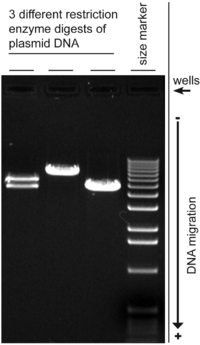
The more dense a band is, the more material there is.
With the gel that I ran, shown below, the left-most column was a mistake, and is to be disregarded. The second from the left is a negative control. It was basically only dye, to have a scale. The third is the positive control. The fourth and final column was my experiment. It was looking for a region called DMR. You see that band at the bottom of the the final one? That is DMR. I found it. However, the problem is the control. It is blurred and crazy. We have no idea what exactly went wrong there.

So the DMR is good, but the control is messed up. We can keep the DMR that I made in PCR, but have to run the control again, else we won't be able to actually experiment with it.
AB decided that he would set up the control for PCR so it would be quicker, and if I noticed anything that he did differently, then we might know what went wrong.
Start to finish, he was done in 15 minutes. He did half of what I did, but when I did it, it took me an 1.5 hours. This means that he did it three times faster than me. I guess practice makes perfect.
LATER: It is now four hours after I wrote that up. AB's new PCR is done. We also ran the gel electrophoresis. We took a picture. You know what? His looks just the same as mine.
This means a number of things. First and foremost, I didn't mess everything up. The other really big thing, is that we have no idea what is wrong. We have pretty much found that it wasn't really the mixing that messed things up. It might be either the quality or quantity of the reagents that went into it. Also, it might be something with the temperature of the thermocycler.
Next week, we will try to address this problem. Possibly, there was too much template DNA. This is odd because this PCR has been successful twice before, but has now failed twice. Possibly, it means that the amount of template DNA is right on the threshold- in the right conditions it might be enough but under the wrong conditions it's too much. We have no idea what the "right conditions" actually are.
Tuesday, April 13, 2010
PCR
Finally, I can sit down to have my heart-attack. For the last 1.5 hours or so, I have been setting up PCR, or the polymerase chain reaction. This is the first step in a much larger process and the first big thing that I have done by myself.
PCR is a very complicated process. The premise is to be able to copy (many, many times) a piece of DNA. There is a particular segment of DNA that you want to study, or in our case you want to study the proteins that bind to that DNA.
A bunch of reagents get mixed together. These include primers, dNTPs, polymerase, buffer, and of course the DNA template. There are forward and reverse primers, each one travelling in one direction along the DNA strand. They are complementary to the ends of the template. dNTPs (deoxynucleoside triphosphates) are the building blocks of DNA. Polymerase is the stuff that actually does the copying/making new DNA.
After mixing these together in the right proportions, which is the only thing I was actually doing for the past hour and a half, they are put into tiny thin-walled test tubes called PCR tubes. This is so that their temperatures can be changed very quickly. There are 50 micro-liters in each tube (about 1 drop of water's worth). These get put into a thermocycler. This is a device that is able to change temperature very quickly, and sustain a certain temperature for a given amount of time. Each temperature allows for different parts of PCR to occur.
First, the mixture is heated a lot. In our case, 94 degrees C. This is to denature the DNA, ie. to make it melty. It separates the bonds of the DNA that would normally make it a double spiral. It is now two single strands.
The temperature now goes down to 55 degrees C. This is the optimal temperature for the primers to attach to the strands. Remember how there is a forward and a reverse? The primer attaches in the middle of the strand, so this is necessary. Also, it can only do reverse in short segments, and these have to get zipped together at the end. Thus, the forward primers need to circle back. The polymerase will now attach to the primer-template hybrid. This is called annealing.
The temperature is raised to 72 degrees C. This is the optimal temperature for the polymerase to make new DNA. The primer is sort of a blueprint for the polymerase to know how/which dNTP to attach to make DNA. This is the extension step.
This process is one cycle. With each cycle you have double the amount of DNA material. We repeat this 45 times. I think that means we end up with 2^45 times the amount of DNA than we originally had as the template. Regardless of the math, it's a tremendous duplication.
At the end, it gets chilled to 4 degrees C, and it can stay there indefinitely. My PCR wont be done before the workday is over, so I can fetch it tomorrow.
I did this all by myself. *pats self on back, and says, "I am terrific."* AB wasn't even looking over my shoulder. Tomorrow, we get to see whether it worked.
PCR is a very complicated process. The premise is to be able to copy (many, many times) a piece of DNA. There is a particular segment of DNA that you want to study, or in our case you want to study the proteins that bind to that DNA.
A bunch of reagents get mixed together. These include primers, dNTPs, polymerase, buffer, and of course the DNA template. There are forward and reverse primers, each one travelling in one direction along the DNA strand. They are complementary to the ends of the template. dNTPs (deoxynucleoside triphosphates) are the building blocks of DNA. Polymerase is the stuff that actually does the copying/making new DNA.
After mixing these together in the right proportions, which is the only thing I was actually doing for the past hour and a half, they are put into tiny thin-walled test tubes called PCR tubes. This is so that their temperatures can be changed very quickly. There are 50 micro-liters in each tube (about 1 drop of water's worth). These get put into a thermocycler. This is a device that is able to change temperature very quickly, and sustain a certain temperature for a given amount of time. Each temperature allows for different parts of PCR to occur.
First, the mixture is heated a lot. In our case, 94 degrees C. This is to denature the DNA, ie. to make it melty. It separates the bonds of the DNA that would normally make it a double spiral. It is now two single strands.
The temperature now goes down to 55 degrees C. This is the optimal temperature for the primers to attach to the strands. Remember how there is a forward and a reverse? The primer attaches in the middle of the strand, so this is necessary. Also, it can only do reverse in short segments, and these have to get zipped together at the end. Thus, the forward primers need to circle back. The polymerase will now attach to the primer-template hybrid. This is called annealing.
The temperature is raised to 72 degrees C. This is the optimal temperature for the polymerase to make new DNA. The primer is sort of a blueprint for the polymerase to know how/which dNTP to attach to make DNA. This is the extension step.
This process is one cycle. With each cycle you have double the amount of DNA material. We repeat this 45 times. I think that means we end up with 2^45 times the amount of DNA than we originally had as the template. Regardless of the math, it's a tremendous duplication.
At the end, it gets chilled to 4 degrees C, and it can stay there indefinitely. My PCR wont be done before the workday is over, so I can fetch it tomorrow.
I did this all by myself. *pats self on back, and says, "I am terrific."* AB wasn't even looking over my shoulder. Tomorrow, we get to see whether it worked.
Friday, April 9, 2010
Really? More Bureaucracy?
First and foremost, I don't think I will ever learn to spell bureaucracy. So, thank yous are in order to the inventor, proprietors, and purveyors of spell-checking technologies.
President Bush signed an executive order that said that all federal employees should use the same wireless access card, where the only difference is the logo of the department you work for. We are currently moving to that system. In order to get this new access card, all federal employees need a background check. Two days ago, I got my email saying that I needed to complete my application for the background check. I went to a special website, and put in my identifying information, and it presented me with a huge mess of forms to fill out.
I mentioned this to AB, who said that maybe I should contact the agency and tell them that I was only interning for a few months, and maybe its a waste of resources? I called them, and they told me that I should go ahead and fill it out. That they will initiate the background check and at whatever point it was left at when I leave they will leave it. I thought that this is a tremendous waste of resources, but there is plenty of waiting time during the day, so it will give me something to do.
It was really in depth. They wanted me to account for every place that I have lived in my life, and who (name, address, phone number) could account for my being there. Relatives don't count. Further, account for every job or period of unemployment since turning 16. Again, someone has to be able to account for my being there. What schools have I gone to? Finally, give three character references (again, no family), with adresses, phone numbers, and length of time that I've known them. They should be able to account for the last five years. It was really intense.
Now, they are going to waste your tax dollars in researching that information.
President Bush signed an executive order that said that all federal employees should use the same wireless access card, where the only difference is the logo of the department you work for. We are currently moving to that system. In order to get this new access card, all federal employees need a background check. Two days ago, I got my email saying that I needed to complete my application for the background check. I went to a special website, and put in my identifying information, and it presented me with a huge mess of forms to fill out.
I mentioned this to AB, who said that maybe I should contact the agency and tell them that I was only interning for a few months, and maybe its a waste of resources? I called them, and they told me that I should go ahead and fill it out. That they will initiate the background check and at whatever point it was left at when I leave they will leave it. I thought that this is a tremendous waste of resources, but there is plenty of waiting time during the day, so it will give me something to do.
It was really in depth. They wanted me to account for every place that I have lived in my life, and who (name, address, phone number) could account for my being there. Relatives don't count. Further, account for every job or period of unemployment since turning 16. Again, someone has to be able to account for my being there. What schools have I gone to? Finally, give three character references (again, no family), with adresses, phone numbers, and length of time that I've known them. They should be able to account for the last five years. It was really intense.
Now, they are going to waste your tax dollars in researching that information.
Subscribe to:
Posts (Atom)