Read the introduction first! Yes, I do like a good parentheses.

Thursday, April 15, 2010

Practice makes perfect

So... my PCR from a couple of days ago kind of failed. Yesterday, I did an agarose gel electrophoresis. This is basically to see whether the PCR was successful, and it was not.

Gel electrophoresis is really cool. You start with an individually sealed package. Inside, is a plastic slab. The plastic slab houses a "gel." In this case the gel is agarose, the sugar-matrix that is made from red algae, and is used in lots of deserts and "seaweed salad" in Asian foods. Read more about it here. The gel has wells at the top. These are very small holes where the gel is cut out. You put the gel-slab rectangle into a bigger plastic box. It is covered with a buffer solution that is electro-conductive. There is a cathode and an anode (positive and negative electric terminals) on either end of the box, the DNA itself is electrically negative. Below is a picture of the slab in the electro-conductive box.


At the top, against the blue background, you can see the wells. A pipette is used to load material (in our case, DNA) into the gel.

First, it is really difficult to get the pipette right into the well, and further to put your material in there. Light is refracted against the buffer solution, and makes aim difficult. You are also using this long pole (the pipette) with a tiny end that needs to fit inside a tiny hole. Regardless, once you have the material in place, you seal the box. It is connected to wires that are connected to a power supply. It's basically a completed circuit. Electricity flows from the anode (negative) through the gel to the cathode (positive). It also pulls the DNA along with it.

Before putting the DNA in the wells, dye was added. This dye, called Ethidium Bromide, binds to each base of DNA- one molecule of dye for each base. This dye allows you to see how far the DNA ran on the gel. The farther the band, the smaller the molecule. Basically, the smaller the molecule, the faster it goes when electrocuted. The location of a band on the gel tells you what you are looking at.

When the electrophoresis is over, you take the gel to a chamber that emits UV light. This is a small light-proof box. You put the gel inside, and seal it up. You turn on the UV light, and can take a picture of the gel using a camera in the box. Ethidium Bromide glows when it is lit by UV light. The resulting photograph shows the bands where there is Ethidium Bromide and thus DNA.

The following is a picture of the UV illumination:
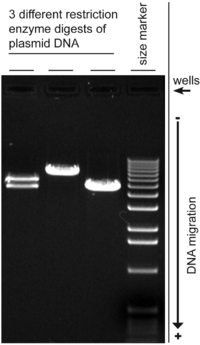
The more dense a band is, the more material there is.

With the gel that I ran, shown below, the left-most column was a mistake, and is to be disregarded. The second from the left is a negative control. It was basically only dye, to have a scale. The third is the positive control. The fourth and final column was my experiment. It was looking for a region called DMR. You see that band at the bottom of the the final one? That is DMR. I found it. However, the problem is the control. It is blurred and crazy. We have no idea what exactly went wrong there.


So the DMR is good, but the control is messed up. We can keep the DMR that I made in PCR, but have to run the control again, else we won't be able to actually experiment with it.

AB decided that he would set up the control for PCR so it would be quicker, and if I noticed anything that he did differently, then we might know what went wrong.

Start to finish, he was done in 15 minutes. He did half of what I did, but when I did it, it took me an 1.5 hours. This means that he did it three times faster than me. I guess practice makes perfect.

LATER: It is now four hours after I wrote that up. AB's new PCR is done. We also ran the gel electrophoresis. We took a picture. You know what? His looks just the same as mine.

This means a number of things. First and foremost, I didn't mess everything up. The other really big thing, is that we have no idea what is wrong. We have pretty much found that it wasn't really the mixing that messed things up. It might be either the quality or quantity of the reagents that went into it. Also, it might be something with the temperature of the thermocycler.

Next week, we will try to address this problem. Possibly, there was too much template DNA. This is odd because this PCR has been successful twice before, but has now failed twice. Possibly, it means that the amount of template DNA is right on the threshold- in the right conditions it might be enough but under the wrong conditions it's too much. We have no idea what the "right conditions" actually are.

Tuesday, April 13, 2010

PCR

Finally, I can sit down to have my heart-attack. For the last 1.5 hours or so, I have been setting up PCR, or the polymerase chain reaction. This is the first step in a much larger process and the first big thing that I have done by myself.

PCR is a very complicated process. The premise is to be able to copy (many, many times) a piece of DNA. There is a particular segment of DNA that you want to study, or in our case you want to study the proteins that bind to that DNA.

A bunch of reagents get mixed together. These include primers, dNTPs, polymerase, buffer, and of course the DNA template. There are forward and reverse primers, each one travelling in one direction along the DNA strand. They are complementary to the ends of the template. dNTPs (deoxynucleoside triphosphates) are the building blocks of DNA. Polymerase is the stuff that actually does the copying/making new DNA.

After mixing these together in the right proportions, which is the only thing I was actually doing for the past hour and a half, they are put into tiny thin-walled test tubes called PCR tubes. This is so that their temperatures can be changed very quickly. There are 50 micro-liters in each tube (about 1 drop of water's worth). These get put into a thermocycler. This is a device that is able to change temperature very quickly, and sustain a certain temperature for a given amount of time. Each temperature allows for different parts of PCR to occur.

First, the mixture is heated a lot. In our case, 94 degrees C. This is to denature the DNA, ie. to make it melty. It separates the bonds of the DNA that would normally make it a double spiral. It is now two single strands.

The temperature now goes down to 55 degrees C. This is the optimal temperature for the primers to attach to the strands. Remember how there is a forward and a reverse? The primer attaches in the middle of the strand, so this is necessary. Also, it can only do reverse in short segments, and these have to get zipped together at the end. Thus, the forward primers need to circle back. The polymerase will now attach to the primer-template hybrid. This is called annealing.

The temperature is raised to 72 degrees C. This is the optimal temperature for the polymerase to make new DNA. The primer is sort of a blueprint for the polymerase to know how/which dNTP to attach to make DNA. This is the extension step.

This process is one cycle. With each cycle you have double the amount of DNA material. We repeat this 45 times. I think that means we end up with 2^45 times the amount of DNA than we originally had as the template. Regardless of the math, it's a tremendous duplication.

At the end, it gets chilled to 4 degrees C, and it can stay there indefinitely. My PCR wont be done before the workday is over, so I can fetch it tomorrow.

I did this all by myself. *pats self on back, and says, "I am terrific."* AB wasn't even looking over my shoulder. Tomorrow, we get to see whether it worked.

Friday, April 9, 2010

Really? More Bureaucracy?

First and foremost, I don't think I will ever learn to spell bureaucracy. So, thank yous are in order to the inventor, proprietors, and purveyors of spell-checking technologies.

President Bush signed an executive order that said that all federal employees should use the same wireless access card, where the only difference is the logo of the department you work for. We are currently moving to that system. In order to get this new access card, all federal employees need a background check. Two days ago, I got my email saying that I needed to complete my application for the background check. I went to a special website, and put in my identifying information, and it presented me with a huge mess of forms to fill out.

I mentioned this to AB, who said that maybe I should contact the agency and tell them that I was only interning for a few months, and maybe its a waste of resources? I called them, and they told me that I should go ahead and fill it out. That they will initiate the background check and at whatever point it was left at when I leave they will leave it. I thought that this is a tremendous waste of resources, but there is plenty of waiting time during the day, so it will give me something to do.

It was really in depth. They wanted me to account for every place that I have lived in my life, and who (name, address, phone number) could account for my being there. Relatives don't count. Further, account for every job or period of unemployment since turning 16. Again, someone has to be able to account for my being there. What schools have I gone to? Finally, give three character references (again, no family), with adresses, phone numbers, and length of time that I've known them. They should be able to account for the last five years. It was really intense.

Now, they are going to waste your tax dollars in researching that information.

Thursday, April 8, 2010

Huh?

Just now, a door-to-door meat salesman came to the door. Who ever heard of such a thing?

journal access

One of my biggest upsets/pet-peeves at Hampshire is the library's access to journals. You do some pretty great searching, find the articles that you NEED, and cross your fingers. Praying to whom/whatever does not seem to help. Occasionally, that article that you need is accessible at Hampshire. More often than not, it's not. Hampshire doesn't have all the money that many more established colleges might. As such, we don't have the library services that other colleges might. Often this can be remedied with a trip to UMass down the road or through inter-library loan (you can request a journal article that we don't have, and usually within a week, a photocopy of it magically appears for your higlighting pleasure). What if it just worked though? What if you could do research, and simply click, and there it is?

I admit I didn't know what I was missing. I was able to deal with the planning ahead that is required in doing research at Hampshire.

The NIH has subscriptions to everything. Just click, and there it is. In PDF, HTML, or other formats. From multiple sources. It's just so easy. And crazy expensive. Again, your tax dollars at work.

Monday, April 5, 2010

The point (sorry, but Ringo is not here)...

I have finally found out the point of what we are doing. It's about time. Until now, I have been doing a whole series of processes without really knowing how they relate to each other, or their end purpose.

We are both a "Core Services" lab and a "Research and Development" lab. Core Services mean that scientists around the country can hire us to do experiments for them. The R&D bit means that we aim to design new technologies and techniques for understanding proteomics. Most labs are one or the other. Both together though works very well. This means that scientists can work with us to design an experiment that will create a new technique or give new understanding in an area.

Apparently, the project that AB and I are working on has immediate applications in cancer chemotherapy. One of the problems of chemotherapy is the toxicity of it. One of the reasons for this is that chemotherapy affects how cells reproduce (at a DNA level). Many chemotherapies, in addition to targeting cancerous cells/reproductions, also inadvertently target the DNA repair mechanism in healthy cells. In a normal healthy cell there is an RNA protein machine that repairs nicks in the DNA. It sort of slides along the chromatin and unzips it in places that need to be repaired. The chemotherapy, however, causes this unzipping to get stuck. The RNA protein machine then sort of tacks on the end of the DNA. If this happens only a couple of times, generally the cell can survive (and this does happen occasionally in healthy cells to no detriment). Unfortunately, if it is continued, it is toxic to the cell. Thus one of the reasons of chemotherapy toxicity. We are looking at interactions of a particular protein with this RNA protein machine. It seems that in vivo (in the actual cell), this protein that we are studying will actually cleave the RNA protein machine off the end of the DNA allowing the DNA to return to normal functioning. If this turns out to always be the case, this protein could be infused with the normal chemotherapy for a cocktail that will reverse the damage that chemotherapy causes.

Here's the thing. I don't believe that it is that simple. It is amazingly difficult to study protein interactions that involve more than say three proteins (and even that many is pretty difficult). While it may be true that the protein that we are studying may be part of this interaction, there is no telling yet whether it is directly responsible for those results. Even so, it's some pretty cool revolutionary stuff.